Pirate Treasures -- Crew Globetrotters
In the summer of 1973, Irish rowing fans fell in love with a striking group of young Americans.
 To be exact, the suntanned college athletes hailed from California. They exhibited yellow highlights in their abundant shocks of hair, suggesting regular exposure to sunshine and saltwater. Chopped rakishly at the collar, their hair-styles reflected Southern Cal's upbeat and easygoing manner.
I too had recently fallen in love with these selfsame Americans and their unique sport: crew.
I was hired two summers earlier, in 1971, as Orange Coast College's director of community relations and sports information. In the fall of '71, I was formally introduced to David Grant, OCC's dean of students and coach of its internationally-recognized rowing team.
I'd heard a lot about Grant in advance of our meeting. I was in awe of his accomplishments. He was, after all, a rowing and sailing genius who hadn't yet reached the age of 45.
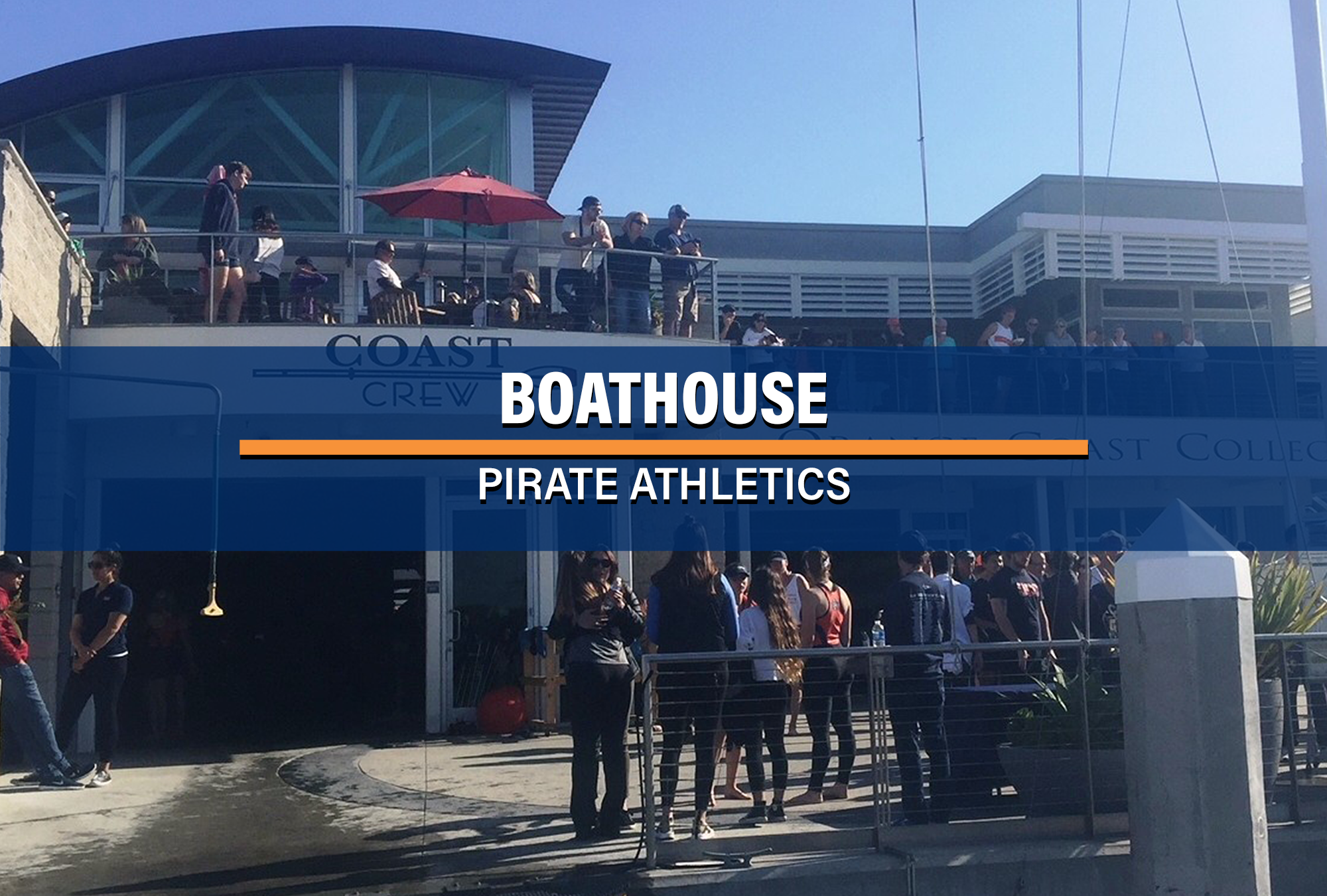
"Jim, why don't you come down to the Boathouse next week and we'll ride in the launch and watch the Pirates go through their morning workout," he suggested. "We'll talk about all things crew."
Who could resist such an offer? I was on a fast-track to "Learning Almost All There is to Know About Rowing." Attending my first boots-on-the-ground regatta cemented things for me. I became an aficionado.
 That was the first of dozens of such invitations coach Grant issued me over the years, and we became good friends.
The ride in the launch – counting strokes, boning up on rowing terminology and etiquette, and following the Coasters down North Lido Channel – opened new worlds for me. For many years as public address announcer for Coast regattas, I called OCC's races from the roof of the Boathouse or in a launch on the 2,000-meter Newport course. Given that the finish line was 700 meters beyond the Boathouse, I had an opportunity to – only slightly, mind you – add theatrics to the final strokes of a race. No one at the Boathouse – except for the guy on the roof -- could see the flag drop as the boats crossed the line. Breathless finishes became my specialty: "Just 10 strokes to go! …"
Over the decades, I followed OCC's men's and women's boats to races in England, Ireland, New York, and up and down the West and East coasts. I've attended dozens of international, national, regional and local regattas and competitions.
I've been keenly aware, of course, of Coast's rowing prowess since I first enrolled as a freshman in 1962. It seemed as if everyone in Newport and Costa Mesa was mindful of OCC's superior rowing program. We were reminded of that with ubiquitous car bumper and rear window stickers proclaiming, "Coast Crew," "Giant Killers," "Go Coast" and "Coast is it!" ("Coast is it!" was the brainchild of my eight-year-old daughter, Jade. Jade's now a 40-ish English teacher with four grown children.)
In June of 1973 Grant, a Coast graduate and former oarsman himself, took his Pirates to England to compete for the second time in the prestigious Royal Henley Regatta, at Henley-on-Thames. Their first trip was in 1971. They, by the way, made their 13th visit in 2018.
 I had the privilege of accompanying them in '73. For me, it was an experience of a lifetime. It was my first of more than a dozen European trips.
OCC's contingent of oarsmen and coaches settled in at the Baskerville Inn in picturesque Shiplake on the river just outside Henley. Afternoon tea was served daily. It was a glorious 15-day stay; the races were conducted in balmy California-like weather. Unremitting sunshine is not the norm for England in June.
Taking advantage of fantastic weather and the rail system, I was able to sightsee much of England before the racing began.
Henley's races are match races -- one-on-one -- over the 2,100-meter Thames River course. Winning boats advance to the next round, losers go home. It's an intimidating, competitive and tradition-laced environment. I had the thrill of following OCC in the coaches' launch.
The Pirates lost by less than half-a-boat-length. They were nipped at the wire by a more experienced, post-collegiate British crew. OCC led most of the way. Were the Pirates disappointed? Of course, but they were also proud … and had every right to be.
 I called the results back to California and dictated a press release to my assistant for distribution. With eight time zones separating London and Orange County, the release landed on editors' desks before they arrived at work.
The Pirates have since won numerous Henley races.
Early Monday morning, following the hullabaloo at Henley, we were scheduled to take a train and ferry from Shiplake to London to Dublin. I awoke Monday with a headache, fever and chills. I was also retching. I told Dave of my condition and he advised that I stay behind at the Baskerville for a day or two, then make my way to Dublin.
Umm.
Weak and wobbly, I boarded the train at Shiplake and concentrated on NOT throwing up. I was prepared to dive to the tracks if necessary to avoid an international incident. I found a bench to lay across at Paddington Station during our transfer in London and passed out. The oarsmen took turns checking on me. We boarded a late-morning train for Wales.
While the oarsmen wolfed down cream cheese and cucumber sandwiches and Cadbury bars, I slept, my head thumping rhythmically against the railcar window. When I awoke at 3 p.m., traversing Britain's Midlands, I felt marvelous. Truly! I never figured it out. How was I able to go from misery to magnificence in mere hours? A youthful constitution, I suppose. To this day, I'm convinced that nothing is worse than traveling whilst ill!
We reached Holyhead, at the western tip of Wales, facing the Irish Sea, at 8 p.m. The ferry pulled out after midnight and arrived in Dublin with the summer sun, at 5 a.m.
 The Pirates competed at the scenic Dublin Regatta on Blessington Lake. OCC's athletes took a week to prepare, with daily technical and sprint intervals on the lake. The pressure was off. The pomp and pageantry of Henley was behind them. Now they prepared to slug it out with the physical Irish crews. The Pirates weren't "out of their league," however. Grant pronounced them ready to go.
Irish fans immediately took to the Americans. Local citizens generously showered them with gifts and sweets, and free meals. Young ladies bashfully introduced themselves to the lads.
Dave's assistant coach that season had the perfect moniker for success on the Emerald Isle: Joseph Flynn. Though born in the Bay Area and a U.C. Berkeley grad, Joe had the temperament and humor of a true Irishman. He served as official translator of the thick brogues encountered by OCC's athletes.
One morning while OCC's eight was on the water putting in a demanding pre-regatta workout, a familiar face showed up at OCC's camp. It was Dr. Joe Tomchak, a longtime Orange Coast College anthropology professor. Joe and his wife, Elizabeth, lived in Newport during the school year but spent summers in France and on Ireland's rugged west coast. "Liz" was native-born Irish. Joe and Elizabeth came to Blessington to cheer the Pirates on.
Tomchak and Dave had been friends since the early 1960s, and both sheltered their boats in Newport Harbor.
OCC's varsity eight went unbeaten at the Dublin Regatta, winning two or three races, as I recall. And, just by being their youthful All-American selves, they won over a nation.
Though knackered, Coast's athletes re-crossed the Atlantic in high spirits.It'd been a glorious trip!