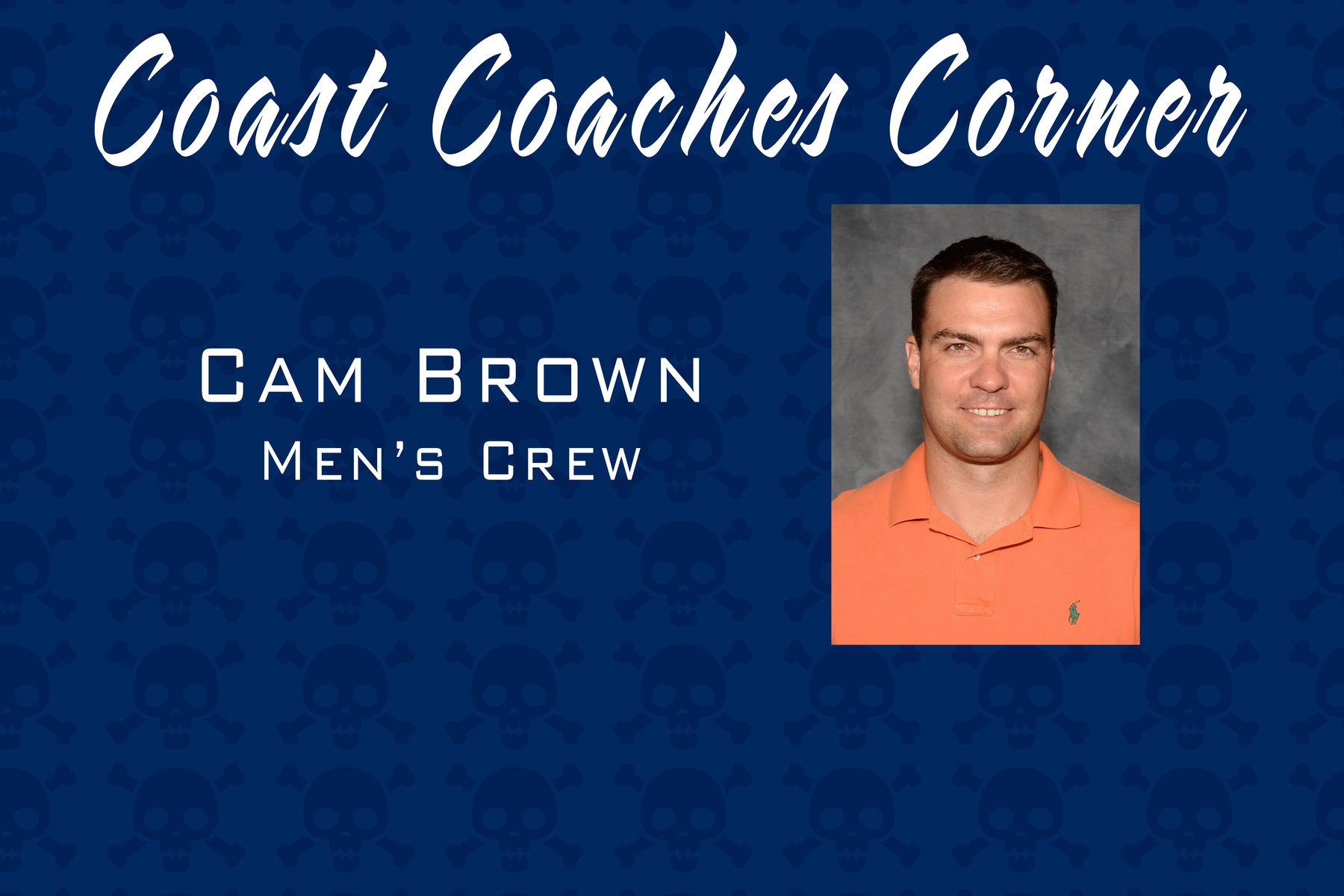
Coast Coaches Corner -- Cam Brown
This week, Orange Coast College shines the spotlight on men's crew coach, Cam Brown. In this installment of Coast Coaches Corner, we talk about Cam's journey from Australia to OCC as well as his battle with overcoming a life-threatening illness and his long-term plans for the Pirate men's crew program.
 So you've been with OCC now for five years … what has that been like?? What was your mindset at the beginning of your tenure and how much has changed since that time?
"It's been a lot of fun and I'm loving it here. When I first came here, I didnt' have a lot of information on the school. As a rower, I had raced against OCC in the past. I knew it was a good program and it was a two-year school and that's pretty much all I knew. Having the opportunity to coach a team like this – a team with a long history, a team that's been around since 1953, a team that has been a success on the national and international level – it's an absolute dream of mine to coach. And I know we still have a lot left to achieve."
What got you in to the sport of rowing?? When did you first start and please talk about what this sport has meant to you in your life? I know the sport is big in Australia, but were you interested in other sports before rowing?
"I started rowing in high school in Australia. I had played 4-5 different sports growing up and I love all kinds of sports and competition. I did several sports in high school and in Australia, if you want to stay in a sport after high school, you volunteer and give back so I helped out with the eighth graders. I still competed at the next level and attempted to make our national team, but I was becoming more and more interested in coaching and I fell in love with it. I went to school and did my studies and all the while, I did coaching and kept in touch with the sports on a volunteer basis. There were lots of long days and I really enjoyed it. I knew I wanted to do this long term and full time, so I made the decision to pursue the coaching pathway. I went to America on holiday (vacation) and I ended up getting a job, then another job and here I am. It all fell in place for me and I'm so happy with how it all happened."
 Once you arrived in the U.S., you worked at a few different sports-related jobs, but was getting back into coaching crew the job you wanted first and foremost?? Talk about rowing in Oklahoma! If you were to have me pick you a state to coach rowing in, I don't think Oklahoma would be atop that list!
"Yeah, it was pretty random … ok it was extremely random! I really did want to get back into rowing and it just so happened that Oklahoma City University started rowing programs and they built this incredible rowing center for Olympic training and there were all levels of rowing programs for all ages. It was a great way to get my start there, so I sent in my resume. I worked with the high school novice girls team and within a year, they hired me full time with the higher-level rowers and off I went!"
During your time at Oklahoma City University, you ended up in the hospital with Guillain-Barre Syndrome, a potentially deadly muscle disorder that occurs when the body's immune system mistakenly attacks the nervous system. If you can, please take me through those first few days/weeks and talk about the recovery process along the way.
 "There are still a lot of unknowns as to what caused it to this day. As best as I can tell, as I was driving the boat trailer from Philadelphia to San Diego, I stopped at a gas station and ate a banana. We later found out, there was a cluster of cases in that immediate area and that's where I was probably exposed to it. It's such a rare condition and for 20 people to get it in that remote area, it's most likely where I got it too. Fast forward six weeks and I go to a national regatta in Princeton at the end of June. Within a 24-hour period, I went from being completely healthy to a quadriplegic. It began in my fingers and toes and I began to feel weaker and my body felt heavier. But it happened so fast that after feeling those things after a couple of hours, I needed to go to a hospital. We had finished the regatta and our boat missed qualifying for nationals by one-hundredth of a second and I told my guys that I needed to get to an ER. I remember walking towards the hospital from the parking lot, I tripped on the curb and that was the last time I ever walked without assistance. My case was one of more of the stronger cases. Most people get a significant or even a full recovery from this, but in my situation, I most likely will never overcome it and you know what? I'm OK with that. My wife, Jessica (fiancée at the time), five months before our wedding, was with me and by my side the entire time. She never questioned it. Her mindset was, 'This is what it is and we will make it work.' She was working full time and after that, she'd come home and become my full-time caretaker. I was completely dependent on others. By the time the following season started, I began to go to practice and I was in a wheelchair. Jess made it all happen for me. She'd wake up at 4 a.m. and make us breakfast, them she'd take me to practice and sit in the car. I was a full quadriplegic for six months and then it was just a gradual return, so the recovery happens phase by phase. I was in a wheelchair for two more years and after that, it was another couple years of recovery. In all, it was a 4-5-year process. The amazing thing was that I never lost sensation, but I just couldn't move. I was literally trapped in my own body. Imagine having an itch on your leg and feeling it, but not being able to scratch it. These days, I've now got full feeling and mobility, but from the knees down, I'm still without control of movement with my feet and ankles. Basically, I take a step and hope it lands properly. On the positive side, anything I really need to do, I can do it. I just have to take it slow and pay attention to what I'm doing. I look at it this way … this is the hand that I've been dealt with, but it could've been a hell of a lot worse. I saw people when I was in the hospital that were permanently paralyzed, and they will never get that back again. I'm just fine."
 At OCU, you were building up a solid program. What was it about the opportunity at Orange Coast College that made you want to pursue moving to California and start over again?
"I met Jess in Oklahoma and we got married and worked there, but we didn't really have plans on staying there long term. She grew up there, but she was ready branch out and start our life in a different area. I always had an appeal to move to the west coast. My family is still in Australia, so moving west would help the travel a little bit. When the OCC coaching position opened up, I researched it and realized that this could be that place. That feeling, five years later, has been solidified. I love the campus and the people I work with. When I first looked into this job, I didn't expect it to be as good as it is and now, my outlook of this being where I want to spend the rest of my life."
Tell us about the recruiting part of this job … I mean this isn't football or basketball or baseball, where it's so much a part of the sports culture in this country. How are you able to get the number of rowers that you get? I know there are quite a few that have never rowed in their life and you're turning them into collegiate-level rowers during their time here. What do you look for in an athlete that makes you think they're up for this experience?
"Rowing is a sport that isn't all that well known. If you've never done it, you don't know much about it. There's been a huge growth at the high school level over the past five years. It's much different than it was 30-40 years ago. It's a bigger sport on the east coast, but there's been a growth of the sport all over the country. So, when it comes to recruiting, it's not as hard as you might think. We know where we are at OCC. We know we are the only two-year school with a rowing program so that makes us pretty unique. We are the steppingstone to get you to your four-year goals. You can improve on your schooling, improve on your rowing, save a lot of money and we will help you get you to where you want to go. You're right … we also DO get athletes who have never rowed before and if you've got the desire and work ethic, we will teach you. We are always looking for tall, long athletes with a good fitness base and with a lot of power … basically, tall, fit and strong. But we have also had great success stories from athletes who weren't tall, fit, strong. Here's the deal … if you can check off three boxes: be on time, do the work and be a good teammate, then I want you on my team … simple as that. The athlete has complete control over all these things and if we can all do that as a team, we can win a lot of races."
 So you get these athletes and I'm sure most of them have no idea what type of work they need to put in to become successful. What are just some of the training methods used with rowing and how many hours of work do these athletes put in before people see the finished product on the water?
"It's not as easy as it looks, that's for sure. For most 2,000-meter races, you're going for 6-7 minutes and you are using all of your energy systems. We have to do a LOT of training every single week of the school year. We are practicing 5-6 days a week and some days, we even do two-a-days. It takes a total, year-round commitment. We have 60-70 guys and we know not all of these guys can make that kind of commitment and that's OK. They've learned about time management and working as a team. By taking this commitment, they are learning things that I hope they take with them for the rest of their lives. We've had many people become very successful in life after their rowing careers were over, whether it's in the military, or in business or in finance. Rowing teaches you all of the disciplines of the workforce. My experience as a rower definitely helped me when I was sick. It gave me the ability to push forward and not allow this disability keep me from getting to where I wanted to go."
So you get the job at OCC and you begin to realize just how daunting a challenge you now have in front of you. Not only do you have to keep alive the consistent winning tradition OCC has established, but you've also got one of the biggest names in all of rowing – Dave Grant -- to try and live up to. How has Dave been for you, in terms of having the ability to give you some expert advice, while at the same time, allowing you the freedom and space to create your own culture and coaching style as well?
"I have been extremely appreciative of Dave since Day 1. I remember before I even moved to California, I received a package from Dave that contained notes and other items that he thought would help me. I have appreciated his help and his friendship and guidance. To have someone like him in my back pocket with all of that experience has been invaluable to me. He comes down every couple weeks to just watch and he offers advice with what he sees out there. He's allowed me to make this program MY program. We will always look at the history of the program and honor it … the impact people like Grant Dave and Jim Jorgensen and others have left here at OCC. We will always follow in their footsteps and … at the same time, I will create this program as my own. Dave allows me to make my own mistakes and learn from them."
 Among the highlights of your five-year stint at OCC was taking the guys to England for the Henley Regatta in 2018, which is one of the most prestigious races in the world. What was that experience like and what will you remember the most from that trip?"
"Our program has been to Henley 13 times, but the last time was in 2002, which was quite a while ago. I wanted to bring that back -- when we were fast enough -- and in 2018, we had a crew that was quite fast, so we made the decision to compete in Henley. To commit to that is no easy task, from a financial standpoint to fundraising and just getting there. If you commit there, you better show up and perform. There's no guarantee that you might not even race! There's a time trial before the regatta and the top 15 crews were able to advance so there was a chance we wouldn't even qualify. We took part in that qualifying race and we ended up being one of the top qualifying boats. After the time trial, they read off the names one by one. I remember we all huddled up and once we heard our school's name … the relief, the excitement and the anticipation hit us all at once. Then, we were able to lineup with another boat from England in the Henley Regatta and we were fortunate enough to beat them. After that, we went up against the University of Washington who ended up setting the course record and won the whole thing, so they took care of us. Most of our guys had never left the state before that and they got to race in Europe and some even stuck around and made it more of a holiday. They talked to me about the experience they got to have in London and checking out the universities and castles … it was a trip of a lifetime. We have a lot of appreciation for our school and our alumni and our community for helping that trip to happen."
 With several regional and national titles during your time at OCC, what are some of your long-term goals with this crew program? Are there higher, realistic goals to achieve with this sport? What more is there to do to get Orange Coast College men's crew to an even higher level of national prominence?
"From a results level, in some ways, a lot of the big goals and achievements have already been reached, but this sport is different than it was 20-30 years ago. I would love to win national championship at the varsity level. From a performance perspective, I want us to be connected with excellence. It already was before I got here, but I'd like us to continue to strive for even more excellence. Personally, my long-term goals involve the lifetime successes of my rowers. Whenever we have our alumni dinner, with rowers from 30-40-50 years ago … it's always a fantastic evening. But, the thing that's so incredible … they always have the same message. Their time at OCC really helped shape and define their lives moving forward. If I can have athletes 20-30-40 years from now say the same thing, then I will have achieved my personal coaching goals. If they come through my program for two years and all I have taught them is to move the boat faster, then I've failed them."
Finally … there's been so much talk about the "OCC Pirate Family" this year with all that's happened in 2020. What does the "OCC Pirate Family" mean to you and how would you like to see that feeling continue to grow throughout our department and throughout our campus?
"I've been here for five years and I feel like our athletic department has a great feeling of getting along with each other. Sure, there's always differences and disagreements here and there, but it's great to see any random coach and get a chance to catch up and see how the other teams are doing. For me, that's what I really enjoy about this department. We can look at each other, and respect what we are all doing and celebrate everything that we are doing. To have that environment, it makes it such a phenomenal place to work."